
Apna Khet Apna Rozgar
Apna Khet Apna Rozgar In Pakistan, especially across rural Punjab and underdeveloped regions, the biggest issue is not willingness to work but the absence of real opportunities. Thousands of young individuals have the energy and intent to earn, yet they remain unemployed because they lack access to land, capital, and proper guidance. Traditional job markets are already saturated, and starting a private business is beyond the reach of most low-income families.
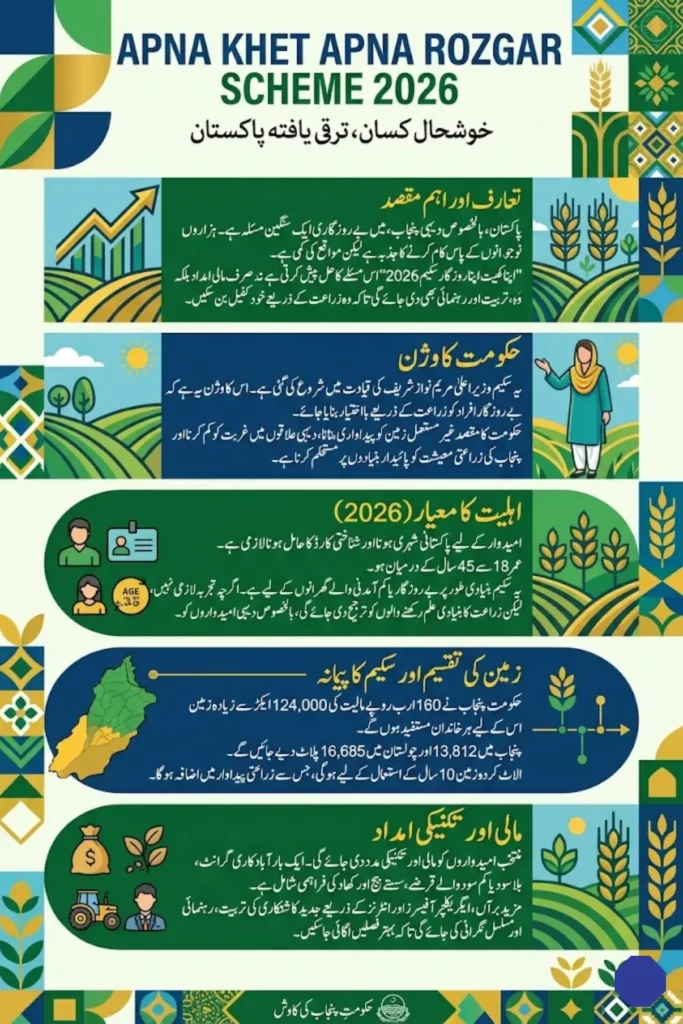
The Apna Khet Apna Rozgar Scheme 2026 is designed to address this exact problem. It introduces a practical and structured approach where individuals are not just given financial aid but are also supported with land, training, and long-term guidance. This makes it one of the most comprehensive rural development programs introduced in recent years.
You Can Also Read: 8070 PSER Registration 2026
For many families, this scheme is not just another government announcement. It is a real opportunity to shift from uncertainty to a stable source of income through agriculture, which remains the backbone of Pakistan’s economy.
Government Vision Behind Apna Khet Apna Rozgar Scheme
The scheme has been introduced under the leadership of Maryam Nawaz Sharif with a clear focus on empowering unemployed individuals through agriculture. The vision is not limited to providing short-term relief but to create long-term economic stability in rural areas.
You Can Also Read: CM Punjab Bewa Sahara Card 2026
The government aims to utilize unused land resources and convert them into productive agricultural units. By doing so, it plans to reduce unemployment while strengthening the agricultural sector at the same time. This approach directly connects economic growth with self-employment.
- Promote self-employment instead of job dependency
- Strengthen the agricultural economy of Punjab
- Support landless farmers with real opportunities
- Encourage youth to enter modern farming
- Reduce rural poverty through sustainable income
This vision shows a shift from traditional aid-based programs to development-based initiatives.
You Can Also Read: CM Punjab Bewa Sahara Card 2026
What Makes This Scheme Different from Previous Programs
In the past, many government schemes failed because they focused only on loans or subsidies without proper follow-up support. As a result, many beneficiaries could not sustain their businesses. This scheme takes a different and more practical approach by combining multiple support systems into one structured program.
You Can Also Read: Punjab Government Launches Bewa Sahara Card
The most important difference is that it provides not just financial help but also access to land and continuous technical guidance. This ensures that even beginners can successfully start farming without facing major risks.
You Can Also Read: CM Punjab Bewa Sahara Card 2026
- Combination of land allocation and financial support
- Long-term land usage period of 10 years
- Regular monitoring by agriculture officers
- Training programs for modern farming techniques
- Focus on sustainable and productive farming
This integrated model significantly increases the chances of success for applicants, especially those who are new to agriculture.
Apna Khet Apna Rozgar Scheme Eligibility Criteria 2026
Understanding the eligibility criteria is essential because even small mistakes can lead to rejection. The government has set clear and simple requirements so that deserving individuals can easily apply.
Applicants must be Pakistani citizens with a valid CNIC and fall within the age bracket of 18 to 45 years. The scheme mainly targets unemployed individuals and those belonging to low-income households. While prior farming experience is not mandatory, it is considered an advantage during the selection process.
- Must be a Pakistani citizen
- Age between 18 and 45 years
- Valid CNIC is required
- Unemployed or low-income individual
- Basic knowledge of farming is preferred
- Rural applicants are given priority
Applicants who can demonstrate practical understanding of farming or have previous exposure to agriculture are more likely to be selected.
Land Distribution and Scale of the Scheme
One of the most important aspects of this scheme is the large-scale land distribution. The Punjab government has allocated agricultural land worth approximately Rs160 billion to support landless farmers across the province.
The scheme covers multiple districts and includes a significant portion of land in Cholistan. The aim is to bring unused land into productive use while providing livelihood opportunities to thousands of families.
| Category | Details |
|---|---|
| Total Land Value | Rs160 Billion |
| Total Land Area | 124,000+ Acres |
| Punjab Plots | 13,812 |
| Families Benefiting (Punjab) | 88,780 |
| Cholistan Plots | 16,685 |
| Families Benefiting (Cholistan) | 101,111 |
| Land Value per Applicant | Rs2.5M – Rs4M |
| Land Usage Duration | 10 Years |
This large-scale distribution highlights the seriousness of the government in addressing rural unemployment.
Financial Assistance and Support System
The scheme does not rely solely on land allocation. It also provides strong financial backing to ensure that farmers can start cultivation without facing financial pressure. This support plays a key role in making the scheme practical and effective.
A one-time resettlement grant is provided to help applicants settle and begin farming activities. In addition, access to low-interest or interest-free loans allows farmers to invest in seeds, fertilizers, and equipment.
- One-time grant ranging from Rs50,000 to Rs250,000 per acre
- Interest-free or low-interest loans
- Subsidized seeds and fertilizers
- Access to tractors and farming tools
- Flexible repayment options
This financial structure reduces risk and enables farmers to focus on productivity rather than financial stress.
Training, Monitoring, and Government Supervision
Another major strength of this scheme is the continuous support provided to applicants after selection. Unlike previous programs where beneficiaries were left on their own, this scheme ensures proper guidance at every stage.
Each land plot is supervised by an agriculture officer who provides technical assistance. Additionally, agricultural interns are assigned to help farmers implement modern farming techniques.
- Regular training sessions on crop management
- Guidance on irrigation and soil fertility
- Monitoring visits twice a year
- Support from agriculture officers and interns
- Assistance in improving crop yield
This structured supervision system increases efficiency and helps farmers achieve better results.
Rules and Conditions for Land Usage
Applicants must clearly understand the rules associated with land usage. The land provided under this scheme is strictly for agricultural purposes, and any misuse can lead to cancellation.
The government has set these conditions to ensure that the land is used productively and benefits the intended purpose of the scheme.
- Land can only be used for farming activities
- Permanent construction is not allowed
- Farmers can choose crops freely
- Land is allocated for a period of 10 years
- Continuous cultivation is required
Following these rules is essential to maintain eligibility and continue benefiting from the scheme.
Step-by-Step Application Process for 2026
The application process is designed to be simple and accessible. However, accuracy is very important, as incorrect or incomplete applications are often rejected.
Applicants need to visit the official government portal and complete the registration process using their CNIC. After filling out the form and uploading documents, the application is submitted for verification.
- Visit official website: akarpunjabgovt.pk
- Register using CNIC
- Fill out application form carefully
- Upload required documents
- Submit application and wait for response
Ensuring correct information and complete documentation can significantly improve approval chances.
Important Dates You Must Remember
Applicants should pay close attention to the official timeline, as missing deadlines means losing the opportunity for the year.
- Application start date: May 2
- Last date to apply: May 18
- Appeal submission: June 1 to June 8
- Final list announcement: June 19
- Land distribution begins: June 30
Preparing documents in advance can help avoid last-minute issues during the application process.
Required Documents Checklist
Proper documentation is one of the most important parts of the application process. Missing or unclear documents can result in rejection or delays.
- CNIC (original and copy)
- Passport-size photographs
- Proof of income if available
- Educational certificates (optional)
- Residence verification details
Organizing documents beforehand ensures a smooth application experience.
Common Mistakes That Lead to Rejection
Many applicants fail not because they are ineligible but due to simple errors. Avoiding these mistakes can significantly increase your chances of success.
- Incorrect CNIC information
- Incomplete application forms
- Unrealistic or unclear farming plans
- Ignoring verification calls or messages
- Submitting unclear or missing documents
Careful preparation and attention to detail are key factors in getting selected.
Practical Tips to Increase Approval Chances
Selection is not only based on eligibility but also on how realistic and practical your application is. Authorities prefer applicants who show clear understanding and planning.
A simple and achievable farming plan is more effective than a large and unrealistic proposal. Demonstrating basic knowledge of agriculture can make a strong impression.
- Choose small-scale farming ideas like vegetables or poultry
- Show understanding of costs and expected profit
- Mention access to land or leasing plans
- Keep your proposal simple and realistic
- Highlight any prior farming experience
These small but important steps can greatly improve your chances of selection.
Real-Life Impact of the Scheme
In many villages, land remains unused simply because people cannot afford to cultivate it. This scheme changes that situation by providing both resources and knowledge.
A young individual with limited income can now start farming with proper support. Within one or two crop cycles, they can generate income and support their family. This not only improves financial stability but also boosts confidence and independence.
The real strength of the Apna Khet Apna Rozgar Scheme 2026 lies in its ability to turn potential into productivity and unemployment into opportunity.
FAQs
Who is eligible for Apna Khet Apna Rozgar Scheme 2026?
Any Pakistani citizen aged 18–45 who is unemployed or from a low-income background can apply.
Is farming experience necessary?
No, but having basic knowledge or experience increases your chances of selection.
Can women apply for this scheme?
Yes, women are encouraged to apply and benefit from the program.
Is the land permanently owned?
No, the land is provided for 10 years strictly for agricultural use.
What happens after selection?
Selected applicants receive land, financial support, and training to start farming.
Conclusion
The Apna Khet Apna Rozgar Scheme 2026 is a well-structured initiative that goes beyond traditional support programs. By combining land distribution, financial assistance, and technical guidance, it offers a complete solution for rural unemployment.
For many people in Pakistan, especially in villages, this scheme can be a turning point. It provides not just resources but a clear path toward self-reliance and economic stability. Those who apply with proper planning and commitment have a strong opportunity to build a better future through agriculture.