Travel Ban Rules 2026 Explained
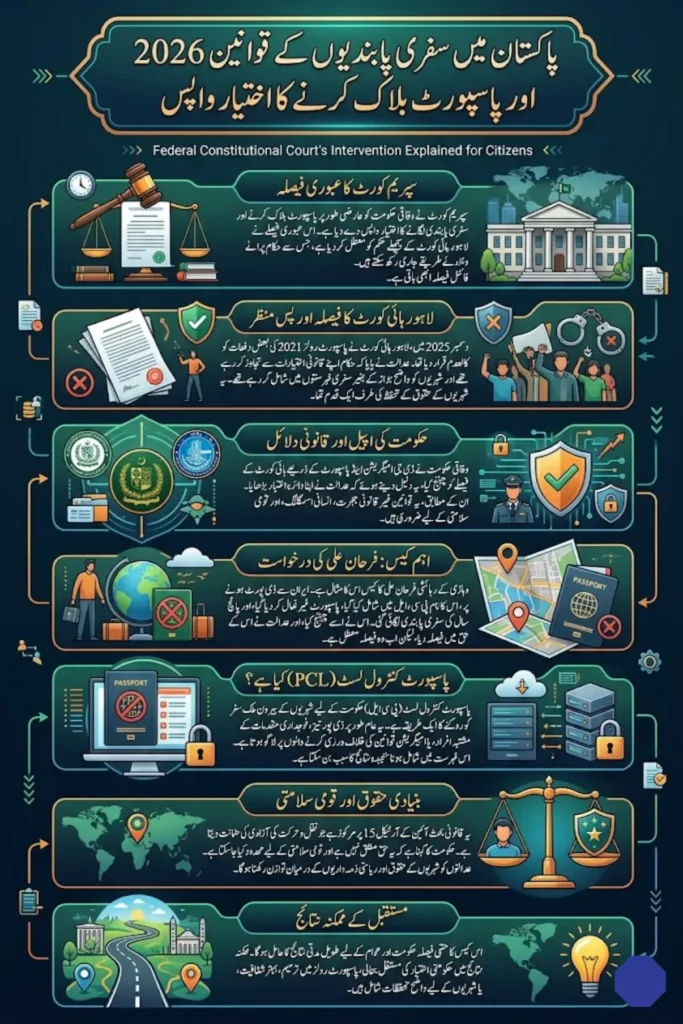
Travel Ban Rules 2026 Explained The Federal Constitutional Court has delivered an important interim decision that has once again shifted the balance of power in favor of the federal government. By suspending a key ruling of the Lahore High Court, the court has temporarily restored the government’s authority to block passports and impose travel bans on certain individuals. This development has quickly become a major topic in legal and public discussions across Pakistan.
From what I have observed while following this case, such decisions do not stay limited to courtrooms. They directly affect thousands of people, especially overseas workers and individuals who frequently travel abroad. The court has not issued a final judgment yet, but this interim relief allows authorities to continue their previous practices, which means travel restrictions will remain in place for now.
You Can Also Read: iPhone 14 PTA Tax Increased in Pakistan April 2026
Key points of this intervention include:
- Suspension of Lahore High Court’s earlier decision
- Temporary restoration of passport blocking powers
- Government allowed to continue travel restrictions
- Notices issued to all concerned parties
- Final decision still pending
Background of the Lahore High Court Decision
In December 2025, the Lahore High Court issued a judgment that challenged certain parts of the Passport Rules 2021. The court concluded that some provisions were being applied beyond their legal limits and could not be justified under existing law. This decision was seen as a strong step toward protecting citizens from excessive administrative control.
You Can Also Read: Late April Snowstorm Warning Across US States
The ruling came after a petition highlighted how individuals were being placed on travel restriction lists without clear justification. The court emphasized that legal authority must always be exercised within defined boundaries, and any misuse of power should be checked through judicial review. For many Pakistanis, this decision brought temporary relief and hope for fair treatment.
Important aspects of that ruling included:
- Certain Passport Rules declared invalid
- Authorities restricted from overusing power
- Focus on protecting individual rights
- Legal clarity demanded in travel restrictions
Government’s Appeal and Legal Arguments
The federal government, through the Directorate General of Immigration and Passports, challenged the High Court’s decision by filing an appeal. Officials argued that the court had gone beyond its jurisdiction and invalidated provisions that were not directly under challenge in the case.
You Can Also Read: Xiaomi 17T Pro Price, Specs, Battery and Launch Details
From the government’s perspective, these rules are necessary to maintain control over illegal migration and human trafficking. Authorities believe that without strict measures, it would become difficult to fulfill both national security requirements and international obligations. Their argument is based on the idea that the state must have the power to act proactively rather than reactively.
Main arguments presented by the government include:
- High Court exceeded its constitutional limits
- Passport Rules are essential for regulation
- Travel bans are lawful under certain conditions
- State must control illegal migration
- National security concerns require strict action
Key Case Details: Farhan Ali’s Petition
The case began with Farhan Ali, a resident of Vehari, who was deported from Iran. Upon his return to Pakistan, authorities placed his name on the Passport Control List, inactivated his passport, and imposed a five-year travel ban. This action had a serious impact on his ability to work and travel abroad.
You Can Also Read: Punjab e-Learn She Earn Program 2026
Feeling that his rights were violated, he challenged the decision in court. The Lahore High Court ruled in his favor, stating that such actions were not legally justified under the existing rules. This case is a clear example of how administrative decisions can deeply affect an individual’s life and livelihood, especially in a country where overseas employment is a major source of income.
You Can Also Read: How to Get Rs. 100,000 from CM Punjab Rahmat Card 2026
This case highlights several important realities:
- Deportation can trigger strict legal consequences
- Travel bans can affect employment opportunities
- Courts provide a platform for justice
- Legal awareness is essential for citizens
Role of FIA and Other Authorities
The Federal Investigation Agency plays a central role in identifying individuals involved in illegal migration and human trafficking. It works alongside passport authorities to monitor suspicious activities and enforce legal measures when necessary. Their involvement is particularly important in cases that involve cross-border crimes.
From my observation of how these systems operate, coordination between different departments is critical. The FIA gathers intelligence, conducts investigations, and then recommends actions such as placing individuals on travel restriction lists. This ensures that decisions are not made randomly but are based on collected evidence and legal procedures.
Key responsibilities of authorities include:
- Investigating illegal migration networks
- Monitoring human trafficking activities
- Coordinating with international agencies
- Supporting enforcement of passport rules
- Protecting national security interests
Understanding the Passport Control List (PCL)
The Passport Control List, commonly known as PCL, is a mechanism used by the government to restrict certain individuals from traveling abroad. It is usually applied to deportees, suspects in criminal cases, or individuals involved in activities that violate immigration laws. Being placed on this list can have serious consequences for a person’s future plans.
For many Pakistanis, especially those seeking jobs abroad, being added to the PCL can be life-changing. It not only stops them from traveling but also affects their financial stability. While the system is designed to maintain order, it also raises questions about fairness and transparency.
Important features of the PCL system include:
- Restricts international travel
- Targets specific individuals based on records
- Linked with passport status and verification
- Can be challenged through legal channels
- Managed by federal authorities
Court’s Interim Decision and Its Implications
The recent interim relief granted by the Federal Constitutional Court has allowed the government to continue placing individuals on the PCL and enforcing travel bans. This means that until a final decision is announced, the existing system will remain in place without any major changes.
This development has created mixed reactions among the public. Some believe it is necessary for maintaining law and order, while others fear misuse of authority. From a practical standpoint, the decision has brought temporary clarity but not a permanent solution.
Key implications of this decision include:
- Government authority temporarily restored
- Travel bans remain enforceable
- Legal uncertainty continues
- Citizens must follow strict compliance
- Final verdict will determine long-term policy
Constitutional Debate on Right to Travel
A major legal question in this case revolves around Article 15 of the Constitution of Pakistan, which guarantees freedom of movement. However, the government argues that this right is not absolute and can be restricted in certain situations, especially when national security is at stake.
This debate reflects a broader challenge faced by many countries: balancing individual freedoms with state responsibilities. Courts must ensure that citizens’ rights are protected while also allowing the government to perform its duties effectively.
Key elements of this debate include:
- Freedom of movement is a fundamental right
- Restrictions can be imposed under law
- Balance between liberty and security
- Need for clear legal guidelines
International Obligations and Security Concerns
Pakistan is a signatory to the United Nations Convention on Transnational Organized Crime, which requires member countries to take strict action against human trafficking and illegal migration. This commitment plays a major role in shaping national policies related to passports and travel restrictions.
Government officials argue that failing to enforce strict rules could damage Pakistan’s international reputation. It could also lead to increased scrutiny from global organizations. Therefore, maintaining strong control over travel and migration is seen as a necessary step.
Key concerns linked to international obligations include:
- Preventing human trafficking
- Controlling illegal cross-border movement
- Maintaining global compliance
- Protecting Pakistan’s reputation
- Strengthening law enforcement systems
Comparison of Legal Position Before and After Interim Relief
To better understand the impact of this decision, here is a simple comparison of the situation before and after the interim relief:
| Aspect | Before Interim Relief | After Interim Relief |
|---|---|---|
| Passport Blocking | Restricted by court | Allowed again |
| Travel Ban Authority | Limited | Fully active (temporary) |
| Government Powers | Reduced | Restored |
| Citizen Relief | Higher | Reduced temporarily |
This table shows how the legal position has shifted back in favor of the government, at least until the final verdict is announced.
Possible Future Outcomes of the Case
Looking ahead, the final decision of this case will have long-term implications for both the government and the public. If the court supports the government, strict passport rules will continue to be enforced. If not, authorities may need to revise their policies to ensure better protection of citizens’ rights.
For ordinary Pakistanis, this case is more than just a legal matter. It affects their ability to travel, work abroad, and support their families. This is why the final verdict is being closely watched across the country.
Possible outcomes include:
- Permanent restoration of government authority
- Revision of Passport Rules 2021
- Introduction of clearer legal safeguards
- Improved transparency in travel restrictions
Conclusion: What This Means for Citizens
From what I have seen and experienced while covering such issues, this case reflects the ongoing struggle between authority and individual rights. The interim decision has given temporary power back to the government, but it has also increased uncertainty for many citizens.
For now, the best approach for Pakistanis is to stay informed and strictly follow immigration laws. Whether you are planning to travel abroad or already working overseas, understanding these rules can help you avoid unnecessary complications. The final decision will ultimately shape how passport control and travel rights are handled in Pakistan in the coming years.