
Private Schools on Fee Collection
Private Schools on Fee Collection The Sindh government has issued fresh guidelines for private schools on fee collection, a move that directly responds to growing concerns from parents across the province. Over the past few years, many families have raised complaints about rising school fees, unexpected charges, and unclear policies that made it difficult to manage household budgets. This new policy aims to bring clarity, fairness, and accountability into the system.
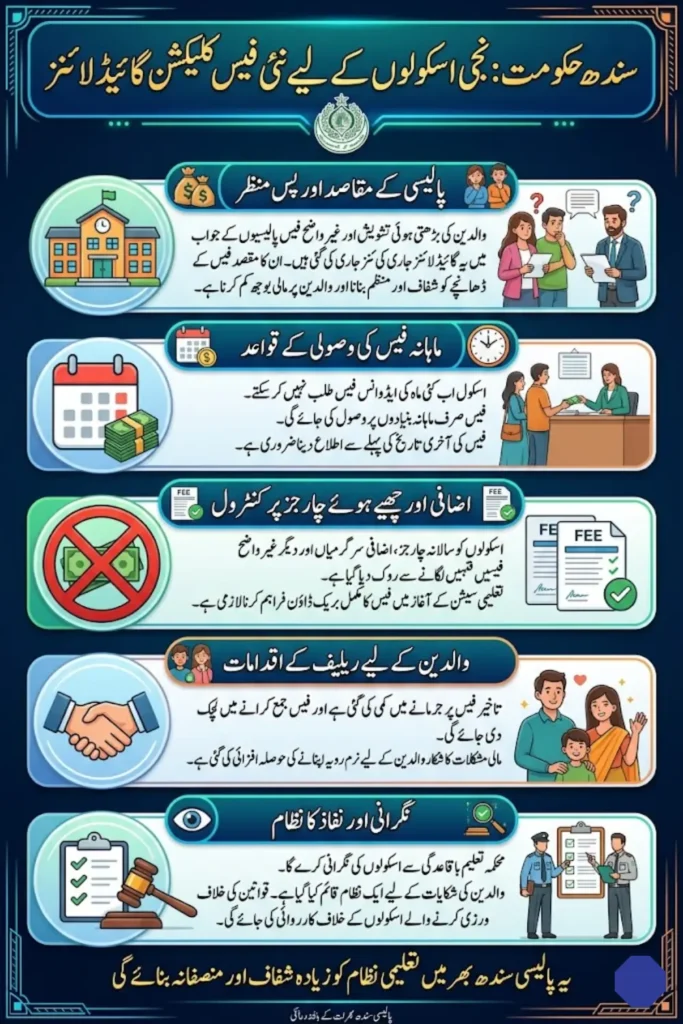
From a ground-level perspective, the issue of school fees is not just about education—it affects the daily lives of middle-class and low-income families. In cities like Karachi, Hyderabad, and Sukkur, parents have often been seen visiting school offices repeatedly to understand fee breakdowns. With these new rules, the government is trying to remove confusion and create a system where parents know exactly what they are paying for and why.
You Can Also Read: Punjab Announces 460 Scholarships for Balochistan Students
Understanding the Purpose Behind the New Policy
The core purpose of these guidelines is to regulate private school fee structures and ensure that no institution exploits parents through unfair practices. The government has recognized that education is a basic need, and financial barriers should not make it inaccessible. By introducing these rules, authorities aim to standardize the system and reduce financial pressure on families.
You Can Also Read: e-Learn She Earn Program 2026 Punjab
Another important objective is to restore trust between parents and school administrations. When fee structures are transparent and predictable, parents feel more secure in planning their finances. This also encourages a healthier relationship between schools and communities, where education becomes the focus rather than financial disputes.
You Can Also Read: Apna Khet Apna Rozgar Scheme 2026
Key objectives of the policy include:
- Ensuring transparency in fee collection methods
- Preventing sudden and unjustified fee increases
- Eliminating hidden charges and unclear costs
- Protecting parents from financial exploitation
- Promoting equal standards across private schools
New Rules for Monthly Fee Collection
One of the most significant changes introduced by the Sindh government is related to monthly fee collection. Previously, many private schools demanded advance payments for several months, placing a heavy burden on parents. This practice has now been restricted to ensure that families are not forced to pay large amounts at once.
The new system encourages a more organized and predictable approach. Schools are required to follow a monthly fee structure and clearly communicate deadlines to parents. This helps families manage their expenses more effectively, especially in times of inflation and rising living costs.
Important rules for fee collection include:
- Schools cannot demand advance fees for multiple months
- Monthly fee must be collected on a regular schedule
- Fee deadlines must be clearly communicated in advance
- No sudden changes in payment timelines are allowed
- Parents should be given reasonable time to submit fees
Controls on Additional and Hidden Charges
A major concern among parents has been the issue of extra charges that are often not explained properly. These include annual fees, activity charges, exam fees, and other miscellaneous costs that appear without prior notice. The new guidelines strictly address this issue by requiring full transparency.
Schools are now obligated to provide a complete breakdown of all charges at the start of the academic session. This ensures that parents are not surprised by unexpected costs during the year. It also creates a system where schools must justify any additional fees they introduce.
To understand this better, here is a simple comparison of allowed and restricted charges:
| Type of Fee | Status Under New Guidelines | Explanation |
|---|---|---|
| Monthly Tuition Fee | Allowed | Must be clearly defined and consistent |
| Admission Fee | Allowed | One-time and transparent |
| Examination Fee | Limited | Must be reasonable and justified |
| Annual Charges | Controlled | Cannot be excessive or hidden |
| Miscellaneous Charges | Restricted | Must be clearly explained |
| Hidden Charges | Not Allowed | Strictly prohibited |
Relief Measures Introduced for Parents
The Sindh government has also focused on providing relief to parents who struggle to meet financial obligations. In the past, strict policies regarding late payments and fines created additional pressure on families. The new guidelines encourage schools to adopt a more flexible and understanding approach.
This change reflects the realities faced by many households, where income is often uncertain and expenses continue to rise. By reducing penalties and offering flexibility, the government is trying to ensure that children’s education is not affected by temporary financial difficulties.
Relief measures include:
- Reduction or control of late payment fines
- Flexible deadlines for fee submission
- Consideration for genuine financial hardships
- No harassment or pressure on parents for delayed payments
- Encouragement for schools to support low-income families
Responsibilities Assigned to Private Schools
With these new guidelines, private schools are now expected to operate with greater responsibility and professionalism. The government has clearly stated that schools must follow transparent practices and maintain proper communication with parents regarding all financial matters.
Schools are also required to inform parents in advance about any changes in fees or policies. This ensures that families are not caught off guard and have enough time to plan accordingly. Such measures can significantly reduce misunderstandings and disputes.
Private schools are now required to:
- Maintain a clear and transparent fee structure
- Provide written notice before any fee changes
- Issue proper receipts for all payments
- Avoid introducing any hidden or unjustified charges
- Follow all government regulations strictly
Monitoring System and Enforcement
To ensure that these guidelines are properly implemented, the Sindh government has strengthened its monitoring system. Education authorities will actively oversee private schools and check whether they are complying with the rules. This step is crucial because policies only work when they are properly enforced.
Parents have also been given the right to raise complaints if they face any issues. This creates accountability and encourages schools to follow the rules more carefully. In case of violations, strict action will be taken against the institutions.
Enforcement measures include:
- Regular inspections by education authorities
- Complaint system for parents
- Penalties and fines for rule violations
- Legal action against repeated non-compliance
- Increased oversight of private institutions
Impact on the Education System in Sindh
The introduction of these guidelines is expected to bring a positive shift in the education sector. When financial matters are handled fairly, it allows schools to focus more on academic quality and student development. Parents, on the other hand, feel more confident and less stressed about managing educational expenses.
From what has been seen in similar situations, such policies can reduce conflicts between parents and school administrations. They also encourage a culture of accountability, where institutions are more careful in their dealings. However, the real challenge will be ensuring that all schools follow these rules consistently.
Final Thoughts and Future Expectations
The Sindh government’s decision to regulate private school fee collection is a timely and necessary step. It reflects an understanding of the challenges faced by ordinary citizens and shows a commitment to improving the education system.
If these guidelines are implemented effectively, they can create a balanced environment where both parents and schools benefit. In the coming months, it will be important to observe how schools adapt to these changes and how strictly the rules are enforced. Overall, this policy has the potential to make education more transparent, affordable, and fair for families across Sindh.