
FBR Stations Tax Officers
FBR Stations Tax Officers A significant development has emerged from Karachi where the Federal Board of Revenue has taken the unusual step of placing tax officers inside a private hospital. This move is part of a broader effort to monitor income directly at the source and ensure that actual earnings match what is reported in official tax records. For many observers, this action reflects a new phase of strict enforcement in Pakistan’s tax system.
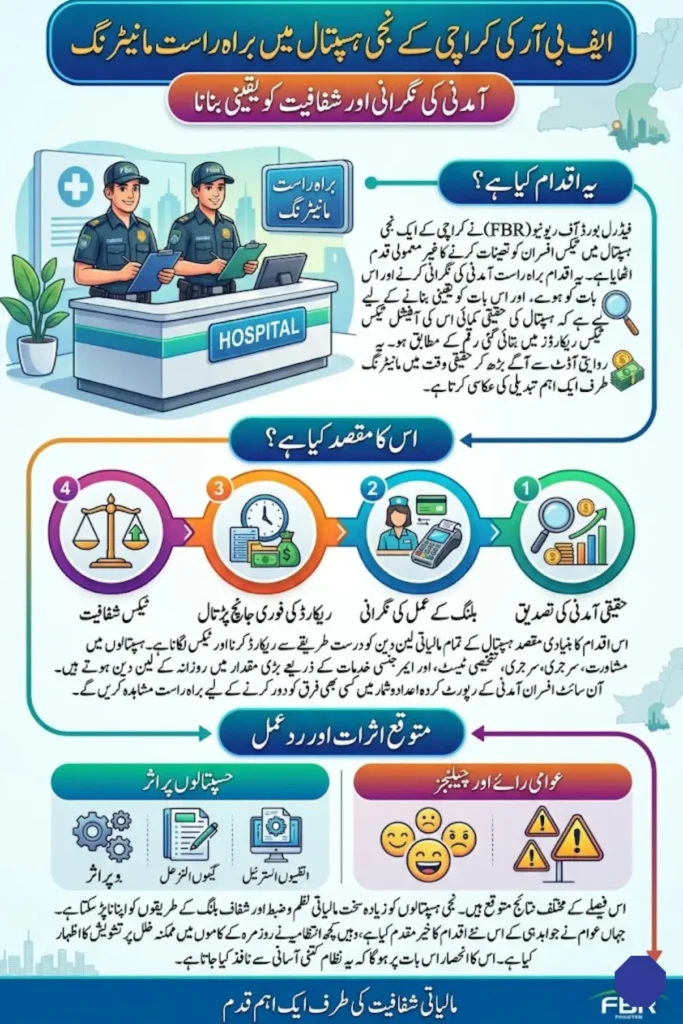
From a ground-level perspective, this is not just another policy update. It is a visible and practical step that shows how authorities are shifting from paperwork-based audits to real-time monitoring. In a country where tax evasion has long been a challenge, such actions are being seen as both necessary and controversial. Many people are now watching closely to see how this decision affects both the healthcare sector and other industries.
You Can Also Read: Sindh Government Releases New Guidelines for Private Schools on Fee Collection
Background of FBR Monitoring Actions
In recent years, the Federal Board of Revenue has been under pressure to improve tax collection and reduce reliance on external borrowing. One of the key issues has been the large undocumented economy, where businesses often underreport income to avoid taxes. Traditional audit systems have not been fully effective in tackling this issue, leading to the adoption of more direct enforcement strategies.
You Can Also Read: Punjab Announces 460 Scholarships for Balochistan Students
Healthcare is one of the sectors where large volumes of daily transactions take place, often involving both cash and digital payments. Authorities believe that without proper monitoring, a significant portion of income may remain unreported. This is why hospitals, especially in major cities like Karachi, are now under closer observation.
Key areas of FBR’s recent focus include:
- Expanding the tax net to include undocumented businesses
- Increasing on-ground inspections instead of relying only on paperwork
- Encouraging digitization of billing and financial systems
- Reducing tax evasion through strict monitoring measures
These steps indicate that the government is serious about improving financial transparency across multiple sectors.
Purpose of Placing Officers in Hospitals
The primary objective behind stationing tax officers inside a private hospital is to ensure that every financial transaction is properly recorded and taxed. Hospitals generate revenue through consultations, surgeries, diagnostic tests, and emergency services, making them financially active institutions with complex billing systems.
You Can Also Read: e-Learn She Earn Program 2026 Punjab
By placing officers on-site, the Federal Board of Revenue aims to eliminate the gap between actual earnings and declared income. This approach allows authorities to observe financial activities as they happen, reducing the chances of manipulation or delayed reporting.
The intended outcomes of this move include:
- Real-time monitoring of hospital income
- Accurate recording of patient billing and service charges
- Prevention of underreporting and hidden transactions
- Building a culture of compliance within private institutions
This initiative is being viewed as a test case that could shape future enforcement strategies in Pakistan.
How Income Monitoring Will Work
The monitoring system introduced in this case is based on physical presence and direct observation. Tax officers are expected to remain within the hospital premises and oversee financial operations, particularly at billing counters and administrative offices. This hands-on approach is designed to ensure that there is no disconnect between what is earned and what is reported.
You Can Also Read: Apna Khet Apna Rozgar Scheme 2026
Officers can review daily financial records, cross-check receipts, and compare digital data with manual entries. This reduces the possibility of discrepancies that often go unnoticed during periodic audits. The presence of officials also acts as a deterrent, discouraging any attempt to hide income.
The process may involve:
- Observing patient billing in real time
- Checking computerized and manual financial records
- Verifying daily income statements
- Ensuring taxes are calculated and reported correctly
| Monitoring Area | What It Ensures |
|---|---|
| Billing Counters | Transparent recording of patient charges |
| Financial Records | Matching of actual and declared income |
| Daily Reports | Immediate identification of discrepancies |
| On-Site Supervision | Prevention of manipulation and fraud |
This system focuses on immediate verification rather than delayed investigation, making it more effective in identifying irregularities.
Impact on Private Healthcare Sector
The presence of tax officers inside hospitals is likely to bring noticeable changes to the private healthcare sector. Hospitals may now be required to maintain stricter financial discipline and adopt more transparent billing practices. For large hospitals, this may not be a major challenge, but smaller facilities could find it difficult to adjust quickly.
From an operational standpoint, this move could increase administrative workload. Hospital management may need to invest in better accounting systems and staff training to ensure compliance. At the same time, it could improve patient trust if billing becomes more transparent.
Possible impacts include:
- Increased accountability in financial reporting
- Greater transparency in patient billing
- Additional administrative responsibilities for hospital staff
- Pressure to upgrade digital systems and record-keeping
While the intention is to improve compliance, the practical impact will depend on how smoothly the system is implemented.
Reaction from Hospital Administration and Public
The response to this development has been mixed. Some hospital administrators have expressed concern that constant monitoring could disrupt daily operations. Hospitals are sensitive environments where efficiency and quick decision-making are crucial, and any external interference may create delays.
On the other hand, many members of the public have welcomed the move. There has long been a perception that private hospitals charge high fees without clear explanations. For these individuals, the presence of tax officers could bring a level of accountability that was previously missing.
Common concerns and opinions include:
- Fear of operational disruption within hospitals
- Questions about patient data privacy and confidentiality
- Public support for transparency in medical billing
- Demand for fair and equal enforcement across all sectors
This mix of reactions shows that while the goal is widely understood, its execution remains a point of debate.
Legal and Regulatory Perspective
Legally, the Federal Board of Revenue has the authority to inspect business records and ensure tax compliance. However, the method of placing officers inside a private institution on a continuous basis raises important legal questions. Experts believe that such actions must be supported by clear legal provisions to avoid disputes.
Another important aspect is data privacy. Hospitals handle sensitive patient information, and any monitoring system must ensure that this data is not exposed or misused. Balancing enforcement with privacy protection will be essential for the success of this initiative.
Key legal considerations include:
- Authority of FBR to conduct on-site inspections
- Need for proper legal framework for continuous monitoring
- Protection of confidential patient information
- Clear guidelines for businesses to ensure compliance
These factors will play a crucial role in determining how widely such measures can be applied in the future.
Challenges in Implementation
Despite its strong intent, the initiative faces several practical challenges. One of the biggest issues is resistance from private institutions, which may see this move as intrusive. Hospitals may also struggle to adapt quickly, especially if they lack modern financial systems.
There are also concerns about the availability of trained personnel. Deploying officers across multiple institutions would require significant resources, which may not always be available. Without proper planning, the system could face delays or inefficiencies.
Major challenges include:
- Resistance from hospital management and staff
- Lack of clear operational guidelines
- Risk of privacy concerns related to patient data
- Limited resources for large-scale implementation
Addressing these challenges will be necessary to ensure that the initiative achieves its intended goals.
Future Implications for Other Sectors
If this model proves successful in the healthcare sector, it could be extended to other industries. Sectors such as education, retail, and real estate are also known for large cash flows and could come under similar monitoring in the future.
This could lead to a broader transformation in Pakistan’s economic system, where businesses are required to maintain full transparency in their financial dealings. Over time, such measures could help increase government revenue and reduce the fiscal deficit.
Possible future developments include:
- Monitoring of private educational institutions
- Increased scrutiny of retail businesses and shopping centers
- Greater regulation of real estate transactions
- Expansion of digital tax systems across sectors
Such steps would signal a major shift toward a more documented and transparent economy.
Conclusion
The decision by the Federal Board of Revenue to station tax officers inside a private hospital in Karachi represents a bold and practical approach to tackling tax evasion. It reflects a growing emphasis on real-time monitoring and direct enforcement, rather than relying solely on traditional audits.
While the move has generated both support and concern, it clearly highlights the government’s intent to strengthen the tax system. The success of this initiative will depend on how well it balances strict enforcement with operational ease and privacy protection. If implemented effectively, it could mark the beginning of a new era of financial transparency in Pakistan.