
Rejects Honda Atlas Appeal
Rejects Honda Atlas Appeal The Lahore High Court has delivered a significant ruling by rejecting an intra-court appeal filed by Honda Atlas Cars Pakistan Limited against an ongoing inquiry of the Competition Commission of Pakistan. This decision has attracted wide attention across Pakistan, especially among car buyers who have long raised concerns about unfair practices in the automobile market.
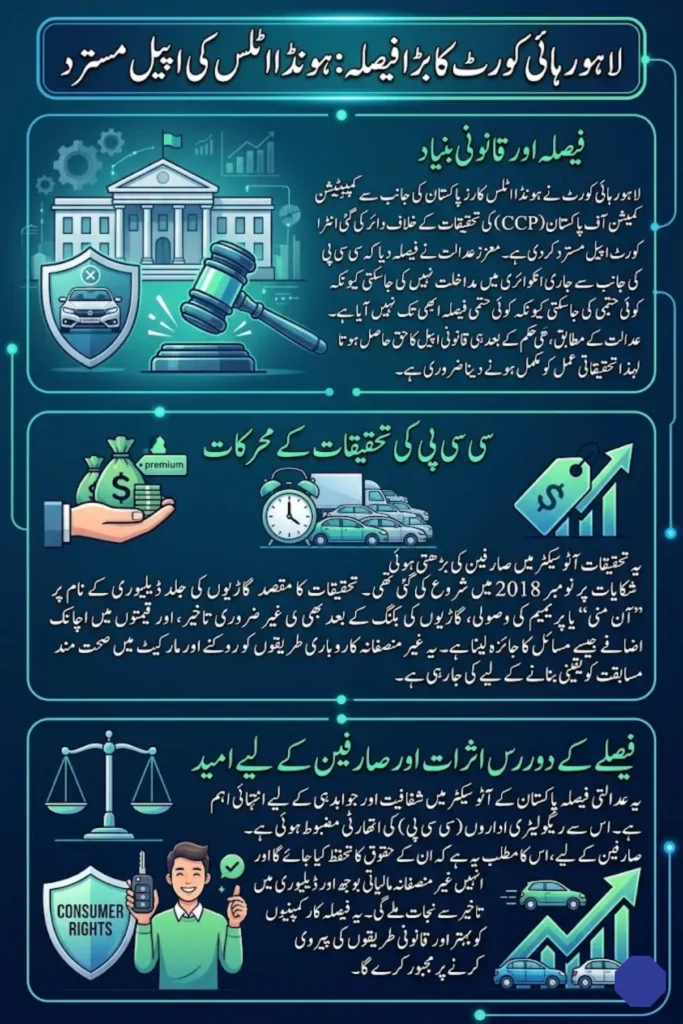
From a journalist’s perspective, this case reflects a larger issue that has been building for years. Ordinary citizens often complain about delayed deliveries, sudden price increases, and extra payments demanded by dealers. The court’s decision now highlights that such matters must be addressed through proper legal channels rather than premature appeals.
You Can Also Read: e-Learn She Earn Program 2026 Eligibility Requirements
Background of the CCP Inquiry
The inquiry launched by the Competition Commission of Pakistan in November 2018 was not a random action. It was based on repeated complaints from consumers and growing concerns about how car companies were operating in the country. The automobile sector, being one of the most important industries in Pakistan, directly affects millions of buyers every year.
You Can Also Read: Pakistan Court Restores Passport Blocking Powers
The regulator started investigating practices that were not only unfair but also damaging to market competition. Many customers shared similar experiences, which made the issue more serious and required official attention. The inquiry aimed to understand whether companies were exploiting their market position.
Key concerns raised during the inquiry include:
- Charging “on-money” or premium for early delivery of vehicles
- Deliberate delays in handing over cars after booking
- Increasing prices even after customers had already placed orders
- Lack of transparency in booking and delivery process
These issues have been widely discussed in Pakistan for years, and this inquiry became an important step toward accountability.
You Can Also Read: iPhone 14 PTA Tax Increased in Pakistan April 2026
Court’s Decision and Legal Reasoning
The court, while rejecting the appeal, clearly explained that such legal action was not appropriate at this stage. The judges emphasized that the inquiry is still in progress, and no final order has been issued by the Competition Commission of Pakistan.
In simple terms, the court said that a company cannot challenge a process that is not yet complete. The proper time to file an appeal comes only after a final decision is made. This approach ensures that the legal system is not misused to delay investigations.
You Can Also Read: Late April Snowstorm Warning Across US States
The court’s reasoning can be understood through the following points:
- Appeals should only be filed after a final order is issued
- Ongoing inquiries must be allowed to proceed without interruption
- Legal hierarchy defined by law must be followed strictly
- Premature petitions create unnecessary delays in justice
This decision shows that the judiciary is focused on maintaining order and discipline in legal proceedings.
You Can Also Read: Xiaomi 17T Pro Price, Specs, Battery and Launch Details
Importance of Competition Act 2010 in This Case
The court strongly relied on the Competition Act 2010, which provides a complete legal framework for handling such matters. This law was created to ensure fair competition and protect consumers from exploitation by large companies.
Under this law, a clear system exists for raising objections and filing appeals. Instead of directly approaching higher courts, companies are required to follow the procedure defined within the Act. This ensures that cases are handled efficiently and in the correct order.
From a practical point of view, this law helps:
- Maintain fairness in business competition
- Prevent misuse of market power
- Provide a structured legal process for disputes
- Protect consumer rights in regulated industries
The court’s reliance on this law shows its importance in Pakistan’s economic system.
Defined Appeals Mechanism and Legal Pathway
One of the main reasons behind the rejection of the appeal was the existence of a proper appeals mechanism. The court clearly stated that Honda Atlas should follow the legal path provided under the Competition Act instead of filing an intra-court appeal.
The appeals process is simple but must be followed step by step. This structured system prevents confusion and ensures that every case is handled fairly.
| Appeal Stage | Authority | Time Limit | Purpose |
|---|---|---|---|
| First Level | CCP Appellate Bench | Within 30 days | Review initial decision |
| Second Level | Competition Appellate Tribunal | Within 60 days | Challenge higher-level orders |
This table shows that there is already a complete system in place. Ignoring this system and directly approaching the court goes against the legal structure.
Court’s Clear Message on Regulatory Authority
The Lahore High Court also made an important point about the authority of regulatory bodies. It stated that the Competition Commission of Pakistan has full power to conduct inquiries and collect information from companies.
This means that companies cannot avoid investigations by questioning the authority of the regulator at an early stage. They are legally bound to cooperate and provide the required data.
Important takeaways from the court’s stance include:
- Providing information to regulators is mandatory
- Companies must cooperate during inquiries
- Jurisdiction challenges at early stages are not valid
- Regulatory bodies must be allowed to complete their work
This strengthens the role of regulators in Pakistan and ensures that investigations are not blocked.
Previous Court Decision and Its Impact
This is not the first time that the court has ruled on this matter. In October 2025, the Lahore High Court had already dismissed a similar petition filed by Honda Atlas. That decision also supported the authority of the Competition Commission.
The latest ruling continues the same approach and shows consistency in judicial thinking. When courts maintain a clear and consistent stance, it helps build trust in the legal system and reduces unnecessary litigation.
For observers, this indicates that the judiciary is serious about enforcing laws related to competition and consumer protection.
Impact on Pakistan’s Automobile Industry
The decision is expected to have a long-term impact on the automobile sector in Pakistan. Car manufacturers will now be more cautious in their dealings, especially when it comes to customer commitments and pricing policies.
From what we have seen in recent years, the industry has faced criticism due to lack of transparency. This ruling can push companies toward better practices and improved customer service.
Possible changes in the industry include:
- Reduction in illegal on-money practices
- Better management of delivery timelines
- More transparency in booking and pricing
- Increased compliance with regulatory rules
This could lead to a more competitive and fair market environment.
Benefits for Pakistani Consumers
For the general public, this decision is a positive development. Many people in Pakistan invest their life savings in buying a car, and unfair practices can cause serious financial stress.
The court’s decision supports the idea that consumers deserve fairness and transparency. It also shows that institutions are working to address their concerns.
Consumers may benefit in the following ways:
- Protection from hidden charges and premiums
- More reliable delivery schedules
- Greater confidence in car booking process
- Improved accountability of car companies
These changes may not happen overnight, but they are a step in the right direction.
Conclusion
The Lahore High Court’s rejection of Honda Atlas’s appeal is more than just a legal decision. It is a message that the rule of law must be followed, and proper procedures cannot be ignored. By reinforcing the authority of the Competition Commission and the framework of the Competition Act, the court has strengthened the system.
For Pakistan’s automobile sector, this case could become a turning point. It highlights the need for transparency, accountability, and respect for legal processes. Most importantly, it gives hope to ordinary citizens that their voices are being heard and that the system is gradually moving toward fairness.