
Petrol Price Near Rs400
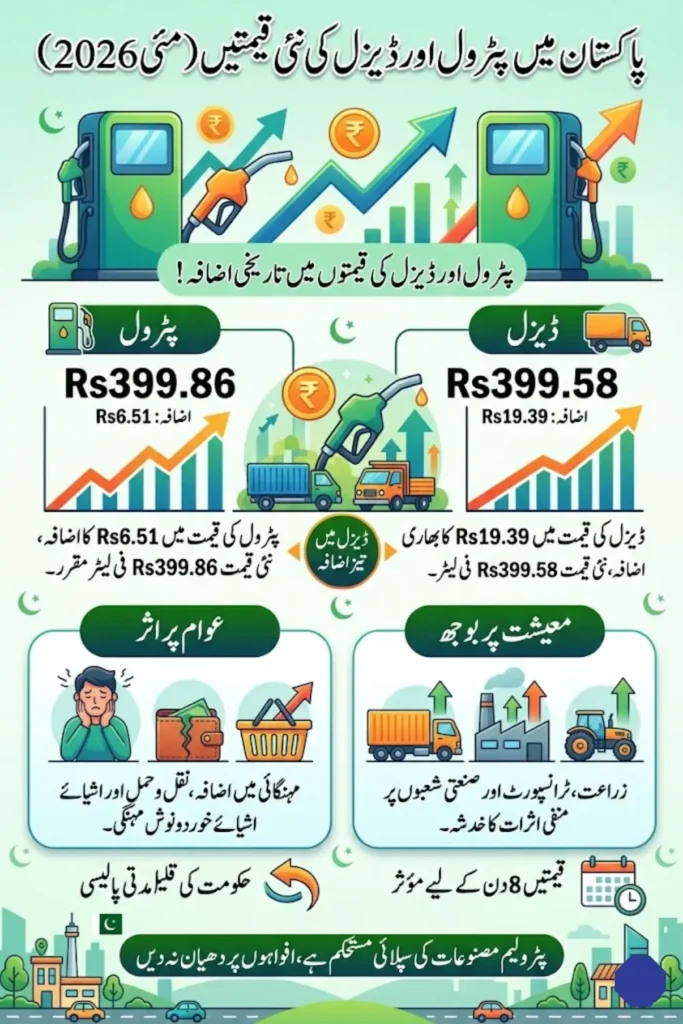
Petrol Price Near Rs400 The federal government has once again raised petroleum prices, pushing petrol and diesel rates close to the Rs400 per litre mark. This latest increase has come at a time when citizens are already struggling with high inflation, making daily expenses even harder to manage. According to official details released on Thursday, the new fuel prices have been implemented from midnight, May 1, 2026, leaving a direct impact on transportation, goods, and overall cost of living.
From what is being observed on the ground, the reaction among the public is a mix of frustration and concern. Petrol pumps saw increased activity late at night before the new prices took effect, as people rushed to fill their tanks. Such scenes are becoming common whenever fuel prices are revised, showing how sensitive this issue is for the average Pakistani household.
You Can Also Read: Oil Prices Cross $120 Iran War, Hormuz Blockade,
The situation reflects a larger economic challenge where fuel prices are no longer stable and are frequently adjusted. This uncertainty is affecting not just individuals but also businesses that rely on transportation and logistics for their operations.
Latest Petrol and Diesel Prices in Pakistan – May 2026
The government has officially announced the revised rates for petrol and high-speed diesel. These new prices are among the highest ever recorded in the country and are expected to influence multiple sectors of the economy.
- Petrol price increased by Rs6.51 per litre
- New petrol price fixed at Rs399.86 per litre
- High-speed diesel increased by Rs19.39 per litre
- New diesel price fixed at Rs399.58 per litre
- New rates effective from May 1, 2026
- Prices applicable for the next 8 days
These changes clearly show that diesel has seen a sharper increase compared to petrol. Since diesel is widely used in heavy transport, agriculture, and industrial sectors, this rise is likely to have a broader impact on the economy.
You Can Also Read: Apna Ghar Scheme 2026 20-Year Housing Loan Plan in Pakistan
Updated Fuel Prices in Pakistan
| Fuel Type | Increase (Rs) | New Price (Rs per litre) |
|---|---|---|
| Petrol | 6.51 | 399.86 |
| High-Speed Diesel | 19.39 | 399.58 |
Prime Minister Approves Fuel Price Hike for Short-Term Adjustment
The decision to increase fuel prices was approved by the Prime Minister after reviewing recommendations from the concerned departments. Officials have stated that the revision is part of a short-term pricing mechanism aimed at adjusting local fuel prices in line with international market trends.
From a policy perspective, these short-term adjustments are becoming more frequent. The government is trying to balance economic pressure with the need to maintain fuel supply and manage import costs. However, for the public, these quick changes often create confusion and financial strain.
It has also been clarified that the new prices will remain in place for a limited period of eight days. After this period, another review will be conducted, which means there is still uncertainty about whether prices will increase further or provide some relief.
You Can Also Read: Lahore High Court Rejects Honda Atlas Appeal
Recent Fuel Price Trends Show Continuous Increase
Looking at recent developments, this is not an isolated increase. Just last week, the government raised petrol and diesel prices by Rs26.77 per litre. With the latest hike, the cumulative increase within a short period has become quite significant.
- Previous increase: Rs26.77 per litre (both petrol and diesel)
- Current increase: Rs6.51 (petrol) and Rs19.39 (diesel)
- Frequent revisions within weeks
- Prices nearing historic highs
This trend shows that fuel pricing in Pakistan is heavily influenced by external factors. The continuous rise is making it difficult for citizens to plan their monthly budgets, as fuel costs directly affect almost every aspect of daily life.
You Can Also Read: e-Learn She Earn Program 2026 Eligibility Requirements
Government Rejects Petrol Pump Closure Rumours
Alongside the price increase, rumours began circulating about a possible shutdown of petrol pumps across the country. These claims created panic among the public, leading to unnecessary concern and confusion.
The Petroleum Division has strongly denied these reports and clarified that there is no plan for any strike or closure. Officials have assured that petrol pumps will continue to operate normally across Pakistan.
- No strike or shutdown of petrol pumps
- Supply chain remains fully active
- Public urged to ignore fake news
- Authorities monitoring misinformation
Such rumours often spread quickly, especially during times of economic uncertainty. The government has emphasized the importance of relying only on official announcements to avoid panic.
You Can Also Read: Pakistan Court Restores Passport Blocking Powers
Petroleum Supply in Pakistan Remains Stable
Despite rising prices and regional tensions, authorities have confirmed that the country’s fuel supply is stable. The Oil Companies Advisory Council has also supported this claim by sharing details about current fuel reserves.
- Petrol stock available for 28 days
- Diesel stock available for 34 days
- No immediate shortage expected
- Supply chain functioning smoothly
This information provides some relief to the public, as it confirms that there is no risk of fuel shortage in the near future. The availability of sufficient reserves means that petrol pumps will continue to serve customers without interruption.
Middle East Tensions and Their Impact on Fuel Prices
One of the major reasons behind the recent increase in fuel prices is the ongoing tension in the Middle East. This region plays a crucial role in global oil production, and any conflict can disrupt supply and increase prices worldwide.
From a broader perspective, Pakistan, like many other countries, depends on imported oil. When global prices rise, local prices also increase as a result. However, officials have reassured that despite these tensions, Pakistan’s fuel supply remains secure.
The government is closely monitoring the situation and taking steps to ensure that imports continue without disruption. Still, the impact of global events cannot be completely avoided.
Public Advisory: Avoid Panic and Misinformation
The government has issued a clear message to the public to remain calm and avoid spreading unverified information. In recent days, social media has played a major role in spreading rumours, which can lead to unnecessary panic.
- Do not believe in unverified news
- Avoid panic buying of fuel
- Follow official government updates
- Help stop the spread of misinformation
Such guidance is important to maintain order and prevent artificial shortages caused by panic behaviour. Responsible sharing of information can help reduce confusion during such times.
Impact of Fuel Price Increase on Daily Life in Pakistan
The increase in petrol and diesel prices will have a direct and noticeable impact on the daily lives of people across Pakistan. As fuel costs rise, transportation becomes more expensive, which in turn affects the prices of goods and services.
For many citizens, this means adjusting their daily routines and budgets. Public transport fares are expected to increase, and businesses may pass on additional costs to consumers. Small traders and delivery services are particularly affected, as fuel is a major part of their expenses.
The overall effect is an increase in the cost of living, which adds to the financial pressure already faced by households. This situation highlights how closely fuel prices are linked to the economic well-being of the public.
Short-Term Outlook for Petrol and Diesel Prices
In the coming days, fuel prices are expected to remain uncertain. The current rates are part of a short-term adjustment, and another revision may take place after eight days.
- Prices may increase further depending on global trends
- Possible adjustments after review period
- Continued impact of international oil markets
- Economic conditions influencing decisions
For now, the public is advised to stay informed and prepare for possible changes. Fuel prices are likely to remain a key issue in the coming weeks, affecting both the economy and daily life.
This latest increase in petrol and diesel prices shows the ongoing challenges faced by Pakistan in managing energy costs. While the government has assured stable supply, the rising prices continue to put pressure on citizens, making it an issue that cannot be ignored.