Petrol and Diesel Prices Increased
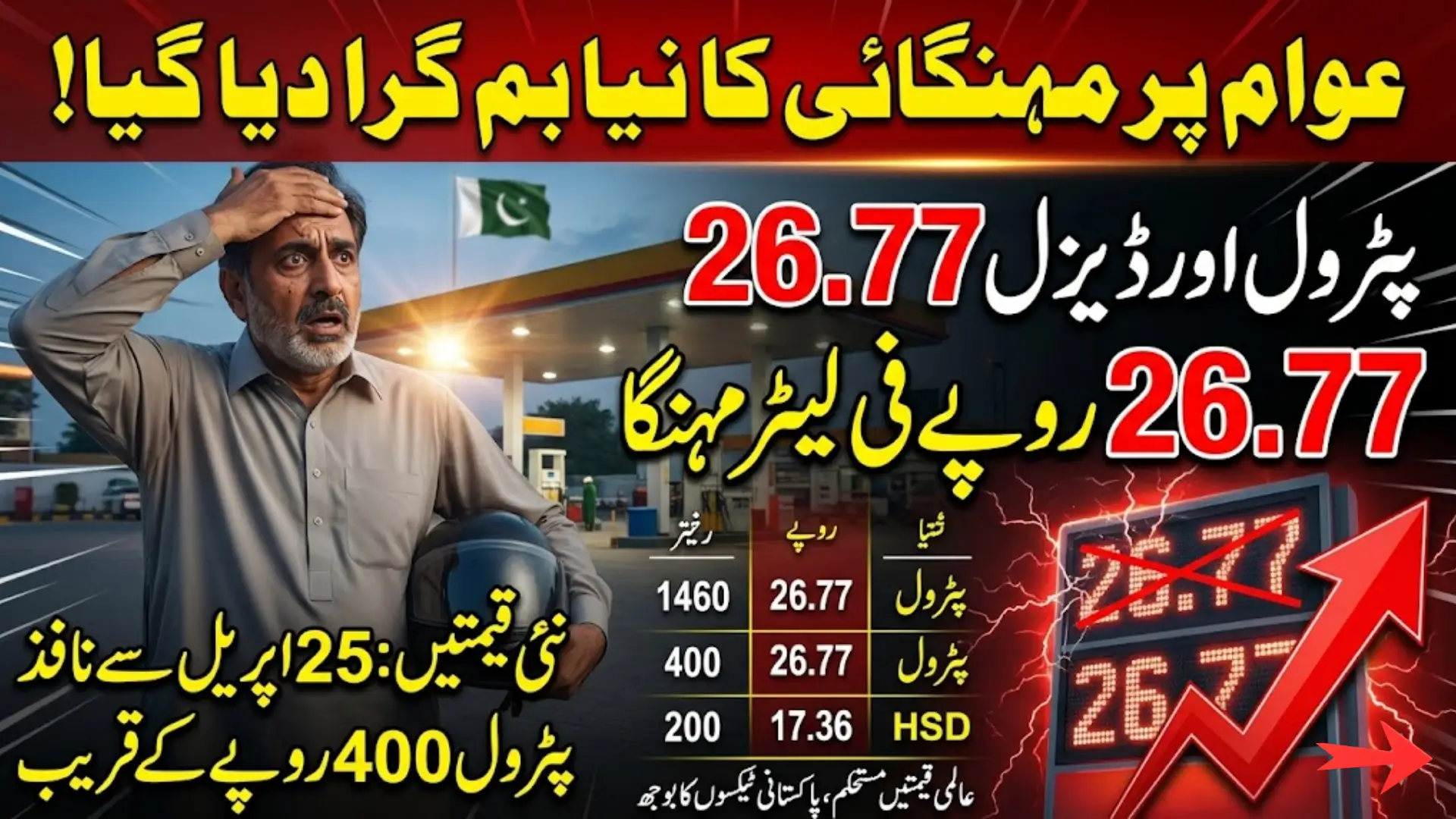
Petrol and Diesel Prices Increased Pakistan is once again facing a sharp increase in petroleum prices, adding further pressure on already strained household budgets. The government has raised both petrol and high-speed diesel (HSD) prices by Rs26.77 per litre, a move that has surprised many citizens because international petrol prices remained largely stable. This clearly shows that the increase is mainly driven by domestic taxation rather than global oil trends.
The decision was approved by Prime Minister Shehbaz Sharif and implemented from April 25. While officials have tried to justify the increase by citing economic challenges and global tensions, the public reaction has been largely negative, as fuel prices directly impact daily expenses, transportation, and essential goods.
You Can Also Read: FBR Increases Customs Values for Imported Used Smartphones
New Fuel Prices in Pakistan April 2026
The latest revision in petroleum prices has brought petrol close to Rs400 per litre, a level that many citizens consider extremely difficult to manage. Diesel prices have also increased significantly, although they remain lower than their historical peak earlier this month.
These new prices are expected to trigger a chain reaction across the economy. Transporters, farmers, and small business owners will all feel the impact, which will ultimately be passed on to the common consumer.
You Can Also Read: FBR Stations Tax Officers Inside Karachi Private Hospital to Monitor Income and Ensure Transparency
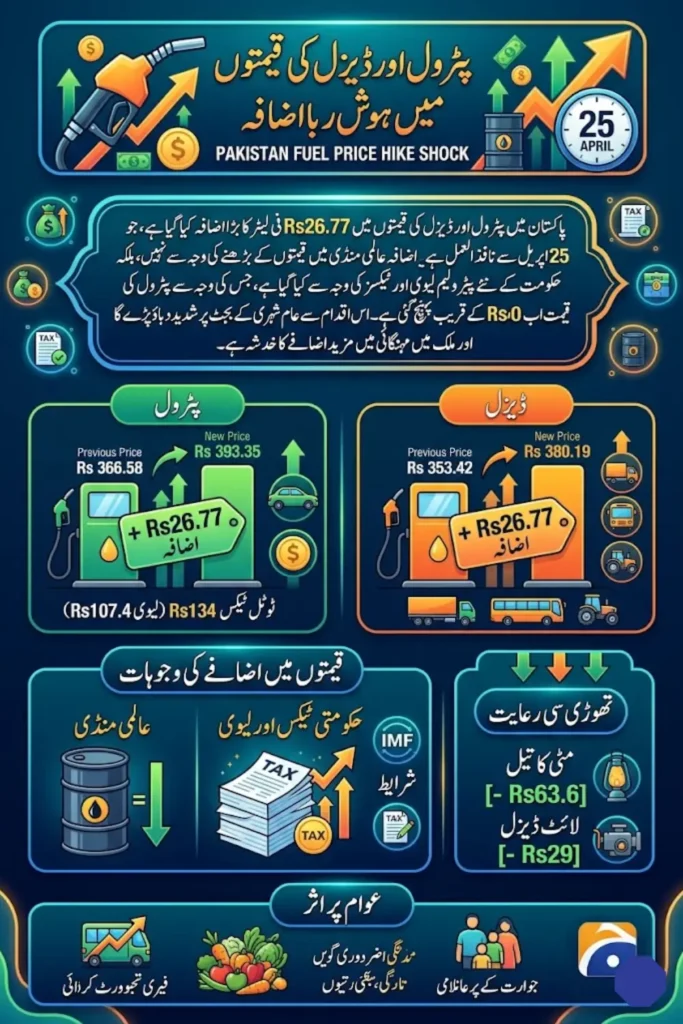
| Fuel Type | Previous Price (Rs) | New Price (Rs) | Increase (Rs) |
|---|---|---|---|
| Petrol | 366.58 | 393.35 | 26.77 |
| High-Speed Diesel | 353.42 | 380.19 | 26.77 |
This increase of over 7 percent in a single adjustment highlights how quickly fuel costs can rise in Pakistan, leaving little time for people to adjust their monthly budgets.
Why Fuel Prices Increased Despite Stable Global Rates
One of the most important aspects of this price hike is that it did not come from international oil markets. Officials from the petroleum sector confirmed that global petrol prices did not see any major increase during this period. Instead, the government decided to raise prices by increasing taxes, particularly the petroleum levy.
You Can Also Read: Sindh Government Releases New Guidelines for Private Schools on Fee Collection
This situation reflects a broader economic reality where governments rely on indirect taxation to meet revenue targets. For ordinary citizens, however, this explanation offers little comfort, as they are the ones directly paying the price at fuel stations.
- No major increase in international petrol prices
- Price hike mainly due to domestic taxation policies
- Government focusing on revenue generation through fuel
- Economic pressure forcing difficult policy decisions
Petroleum Levy Increase and Tax Burden on Public
The petroleum levy has now become one of the biggest components of fuel pricing in Pakistan. The government has increased the levy on petrol to Rs107.4 per litre, which is a significant burden on consumers. When combined with other taxes, the total tax on petrol reaches approximately Rs134 per litre.
You Can Also Read: Punjab Announces 460 Scholarships for Balochistan Students
This means that a large portion of what people pay at fuel stations is not for the fuel itself but for taxes. Diesel, in comparison, carries a lower tax burden, which indicates a policy choice to protect certain sectors like transport and agriculture.
- Petroleum levy on petrol: Rs107.4 per litre
- Total tax on petrol: Around Rs134 per litre
- Diesel tax significantly lower than petrol
- Climate support levy and customs duty also included
This unequal distribution of taxes has raised concerns among citizens, especially petrol users who feel they are being unfairly targeted.
IMF Conditions and Government Strategy Behind Price Hike
Pakistan’s agreement with the International Monetary Fund plays a key role in these decisions. Under the bailout program, the government is required to increase revenue, and petroleum levy is one of the easiest ways to achieve this target.
Sources indicate that the IMF has asked Pakistan to impose a tax of Rs80 per litre on both petrol and diesel. However, the government has chosen to place a higher burden on petrol users instead of equally distributing the tax.
- IMF requires higher revenue collection through fuel taxes
- Government using petroleum levy to meet targets
- Additional Rs53 per litre tax still under consideration
- Future price increases cannot be ruled out
This strategy may help the government meet its financial commitments, but it continues to increase financial stress on the general public.
Impact of Petrol and Diesel Price Increase on Daily Life
Fuel price increases in Pakistan do not stay limited to petrol pumps. They quickly spread across the entire economy, affecting transportation, food prices, and basic living costs. Diesel is particularly important because it is widely used in goods transport and agriculture.
For ordinary citizens, especially those who rely on motorcycles or public transport, this increase directly affects daily life. Even small businesses and shopkeepers are forced to raise prices to cover higher transportation costs.
- Increase in public transport fares
- Higher prices of vegetables and essential goods
- Rising cost of delivery and logistics
- Financial pressure on middle and lower-income families
This situation makes it harder for people to manage their monthly expenses, especially in a time when inflation is already high.
Relief in Kerosene and Light Diesel Oil Prices
While petrol and diesel prices have increased, the government has provided some relief by reducing the prices of kerosene oil and light diesel oil. These reductions are linked to a decrease in global oil prices for these specific products.
However, the benefit of this reduction is limited, as these fuels are not as widely used as petrol and diesel in urban areas.
- Kerosene oil reduced by Rs63.6 per litre
- New kerosene price: Rs365 per litre
- Light diesel oil reduced by Rs29 per litre
- New light diesel price: Rs270 per litre
Although this step offers some relief, it does not significantly offset the overall impact of rising petrol and diesel prices.
Government Revenue from Petroleum Levy
The government has already collected more than Rs1.2 trillion through petroleum levy during the current fiscal year. This amount represents about 82 percent of the total annual target, showing how important fuel taxation has become for Pakistan’s economy.
This heavy reliance on fuel taxes raises concerns about sustainability, as it places a continuous burden on consumers rather than expanding the tax base.
Future Outlook for Fuel Prices in Pakistan
Looking ahead, there is a strong possibility that fuel prices may continue to rise. The government still needs to meet IMF targets, and additional taxes may be introduced in the coming weeks. The planned increase in climate support levy from July 1 will also add to the cost.
Uncertainty in global oil markets due to regional tensions further complicates the situation. For Pakistani citizens, this means that fuel prices may remain unstable in the near future.
Government موقف and Official Statements
Petroleum Minister Ali Pervaiz Malik stated that rising regional tensions are putting pressure on oil prices globally, forcing the government to pass on the burden to consumers. He also mentioned that the government has tried to absorb the increase as much as possible.
Despite these statements, the reality on the ground tells a different story. Citizens continue to face rising expenses, and fuel prices remain one of the biggest contributors to inflation in Pakistan.